instagram

Showing posts with label Transit. Show all posts

Saturday, October 26, 2019

Metro's Blue Line Vintage Sign Auction Nets $30,000; Yes, I Bought One


As the Metro prepares to reopen its Blue Line on November 2 after major renovations, the big news is that it will now be known as the "A Line" -- as the L.A. rail system moves away from a color-coded system to a letter-based one. That also means many of the Blue Line's old signs are obsolete.

On Thursday, the Metro Shop held a Metro Blue Line Celebration and Vintage Sign Auction, pulling in at least $30,000 as people — including, yes, me —— purchased some of the old, retired signs from the line. Some of that money will go toward paying for the event; the rest will go back into Metro's general fund.

I was looking for one that said "Los Angeles," and managed to win one (although it wasn't cheap). Most of the major signs fetched $150 to $200, but there were deals for smaller signs. Around 300 vintage Blue Line signs that have been replaced were auctioned to the public; I wonder what happened to the others. (Go here to see how much each sign ultimately fetched.)

The event itself took place at the Union Station historic ticketing hall, and featured food, beverages and live music by Maria de la Vega & the Wayward Five. Some pics:


And yes, this is the one I ultimately purchased.


Tuesday, August 9, 2016

Hello, Expo Line: We Finally Make the Trip to Santa Monica

Expo Line

No, New York Times, it is NOT the "Subway to the Sea." It's not a subway, first off. (The Metro Purple Line, which could be the "Subway to the Sea" one day, is so far only scheduled to reach as far as Westwood. The NYT hasn't issued a correction yet.)

Expo Line

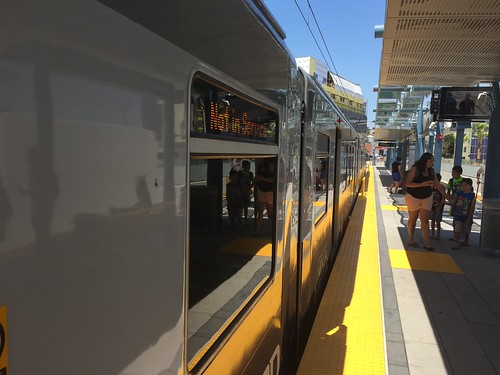
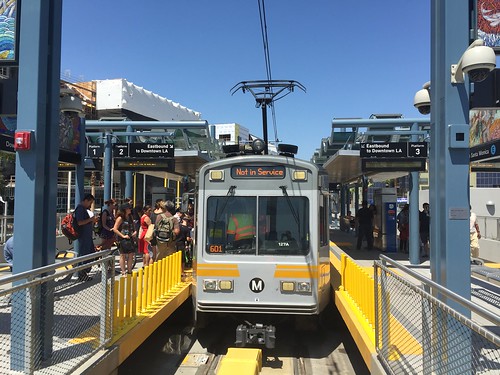
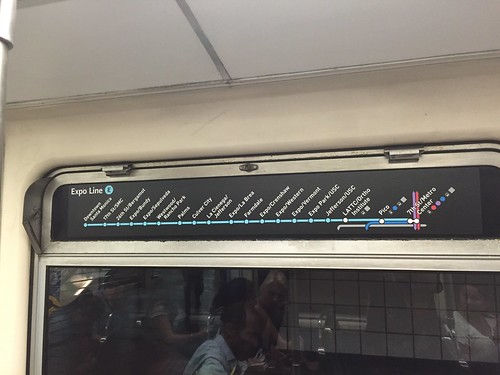
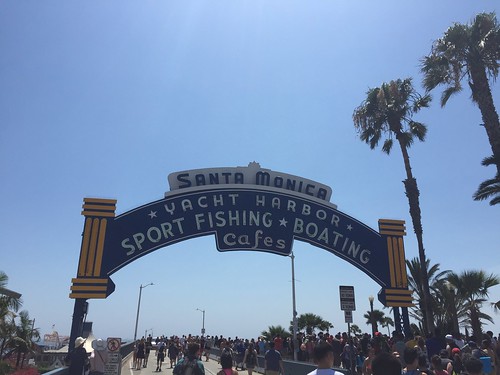
But the Metro Expo Line DOES reach the sea, and that's been one of the big game changers this year when it comes to public transportation in Los Angeles. We recently finally rode the length of the Expo line, from 7th Street downtown, all the way to the ocean.

Expo Line

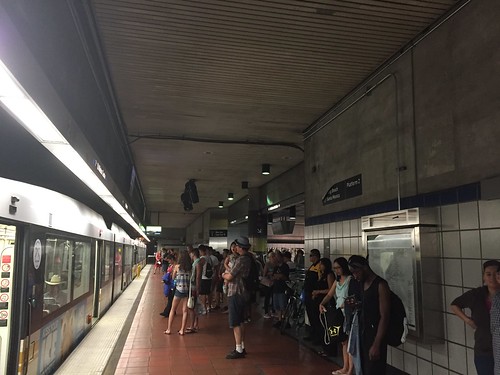
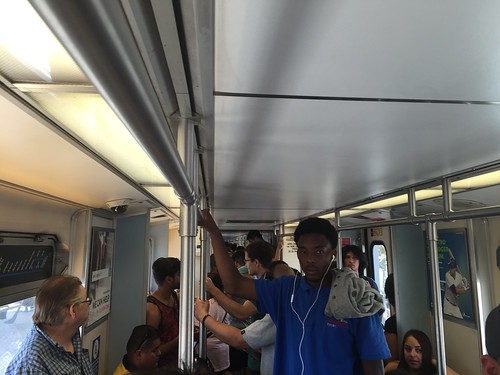
A few snap observations: As the Metro itself has admitted, the Expo Line needs more train cars, at least on the weekend. Apparently the additional train cars have been ordered... but for now, the trains are crowded. And on the weekend, people are mostly heading to the very end -- meaning the train gets busier and busier up until the end of the line.

Thankfully, having started at the beginning of the line, we had seats.

Expo Line

Next: Keep your fingers crossed you get a newer train car. On the way down, we road in an older train, built in the late 1980s and probably been in use since the Blue Line first opened in 1990. The air conditioning was not existent, making the car hotter and hotter as more people climbed on board. (We had a newer train on the way back, and it was cool riding.)

Expo Line

The ride itself is very pleasant, and offers interesting views of the city -- including Exposition Park and its museums, and a great view of the Hollywood Hills (including the Hollywood sign) during the elevated sections.

Expo Line

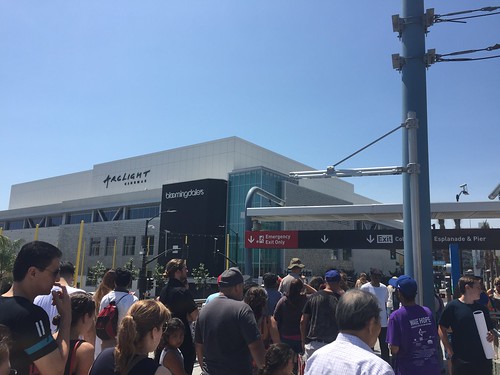
Things get pretty crowded at the end of the line, as crowds disembark and wander every which way into Santa Monica. But to be so close to the ocean, it's a dream come true -- our TRAIN to the sea has arrived!

Expo Line

Most importantly, the Expo Line has now CHANGED THE GAME when it comes to the Great Los Angeles Walk! For the first time this year, there will be an easy rail option to get to and from the start and finish lines!

Friday, February 8, 2013

Retro Friday: Trolleys in Los Angeles


As a follow up to last week's Retro Friday about the final days of the famed Red Cars, here's an interesting find from the Metro librarian's collection. It's a silent film clip that doubles as archival footage of early horse-drawn and electric streetcars or trolleys in Los Angeles.

Friday, February 1, 2013

Retro Friday: The Last of Los Angeles' Red Cars


In honor of the 20th anniversary of Los Angeles' Metro Red Line (which first opened in 1993), here's a color film chronicling the end of the run of L.A.'s original transit system -- which was completely scrubbed by 1961.

Friday, January 18, 2013

Retro Friday: Street Safety in 1930s Los Angeles (Filmstrip)


Don't Be foolish! Obey the Law! Cross Streets Carefully! Think Of Your Parents!

Los Angeles streets in the 1930s look like the Wild West in this safety filmstrip -- but I suppose the whole concept of street culture was relatively new back then. No seat belts, no speed limit, no safety measures to prevent tragedies. This film (no sound, sorry) gives us a glimpse into busy 1930s L.A. surface streets, including the heyday of the Red and Yellow Cars. Watch above.

Friday, March 23, 2012

Expo Line Opens Next Month; But Please, Metro, Change the Name


Big news: Phase one of Metro's Expo line from downtown to Santa Monica (ending, for now, at La Cienega) opens on Saturday, April 28. Reports Metro's The Source blog:

The line will initially open between 7th/Metro Center station in downtown Los Angeles and the La Cienega station. The final station on the first phase of the project, at Venice and Robertson in Culver City, will open this summer.

Meanwhile, construction has begun on the second phase of the Expo Line between Culver City and Santa Monica. That part of the project — funded by the Measure R sales tax increase approved by L.A. County voters in 2008 — is scheduled to open in 2015.


For now, it looks like Metro is committed to calling it the "Expo Line." I honestly thought the agency would have come to its senses by now and gone back to the original plan, calling it the "Aqua Line." Every other line on Metro's system is named after a color -- and this will stick out like a strange anomaly.

In case you forgot, "Expo Line" was the compromise after the 2006 battle over the name. Blame City Councilman Bernard Parks -- here's a snip of what I wrote at the time:

Back in 2000, the guerrilla pop art group Heavy Trash erected several gag signs around town promoting a fake "Metro Aqua Line" from downtown to the ocean.

When the MTA approved its Mid-City/Exposition Light Rail Transit Project, it actually took a cue from the Heavy Trash group and dubbed it the "Aqua line."

Here's where it gets unnecessarily complicated: City Councilman Bernard Parks has decided he doesn't like the "Aqua line" name, the L.A. Times reports today. He also doesn't like the MTA's other suggestion, the Purple Line.

Why? "Those are colors that don't resonate," Parks explained.

Huh?

Parks proposes that the new extension be called the "Expo Line" -- even though every other line on the MTA's rapid transit system are named after colors (Red, Green, Blue and Gold). His other option? The "Rose Line."


Metro eventually renamed the Wilshire spike of the Red Line (which was its own source of confusion) the "Purple Line." But as for the "Aqua Line," unfortunately, Metro caved, and it's been called the "Expo" line ever since. But the Expo Line is branded with a light blue, "aqua" color -- perhaps with the hope that sanity will prevail and the line will follow the cue of the Metro's color-coded system.

Thursday, February 23, 2012

A Little Ditty About L.A. Public Transportation


Boyle Heights-based hardcore band It's Casual has come up with an ode to public transportation in Los Angeles. "The Redline," the first single from the band's upcoming release "The New Los Angeles Part I: Through The Eyes Of A Bus Rider," looks at what it's like to avoid the freeways and take public transportation (and a skateboard) to work. (In real life, It's Casual lead singer Edward Solis doesn't own a car and really does ride public transportation.)

Rick Kosick ("Jackass") shot and directed the video, above. The group's album is released on March 13.

Friday, January 20, 2012

Retro Friday: Los Angeles Automobile Love, Circa 1976


Interesting find from the always fascinating Metro Librarian collection: A 1976 film recounting Los Angeles' transit history and discussing the problems with modern mass transit. (Remember, this is before the return of rail.)

Friday, May 13, 2011

Retro Friday: Die Day in Los Angeles, 1963


From the Metro archives. Above, March 30, 1963 -- the final day of service for L.A.'s streetcars.


And to go really back, here's a training film from 1914 for L.A.'s Pacific Electric cars.

Tuesday, January 18, 2011

Alex P. Keaton's Dad on Rail Safety


Michael Gross -- yes, Steven Keaton to you and me -- stars as the voice of reason in this unintentionally semi-hilarious MTA safety video. Just to make clear, driving in front of a rapidly moving Metro train is *not* a good idea.

BTW, I also learned a bit of Michael Gross trivia tonight, if you want to believe Wikipedia. The site said Gross was behind the painting that opened every episode, yet I can't find that info anywhere else, so take it with a grain of salt.

Tuesday, May 25, 2010

What Could Have Been: The 1970s-era Los Angeles Monorail That Wasn't


Los Angeles transit history is littered with proposals and projects that never got off the ground.

Of course, we're now all left to wonder whether L.A. would be easier to navigate had a system been put in place nearly 40 years ago. But no matter -- what's done is done, and we still don't have a subway to the sea.

L.A. Times freelancer Steve Harvey put together a list of the more outlandish rapid transit ideas over the years, including the monorail.

More:

In the 1960s and '70s, plans were drawn up for elevated "people-movers" in L.A.'s Civic Center. Drawings showed what looked like "Star Wars" vehicles zipping over traffic on Spring Street.

But the concept was opposed by San Fernando Valley legislators who thought their region was being left out. (Even the Aerial Swallow had included the Valley in its plans.) L.A.'s "people-mover" idea didn't go anywhere.

Check out our 2007 Franklin Avenue post on L.A.'s failed rapid transit plans here. It includes a link to maps of old proposed transit plans -- as well as the link to a 1954 Fortune article touting the future of a monorail in L.A.

Monorails, of course, have been discussed for years as an L.A. rapid transit option -- particularly after Walt Disney constructed a mini version for Disneyland. Ray Bradbury was also a big proponent. The push hasn't died down, as real estate developer and potential City Hall candidate Rick Caruso has discussed the option.

But as the commenters on this Curbed L.A. post note, there's a host of reasons why monorails won't make sense. First off, subways are more safe in the event of an earthquake. The idea of a monorail is romantic, but not practical.

Friday, March 19, 2010

Exploring L.A.'s Railway Past in Perris


Driving to Perris, California -- deep inside the Inland Empire -- is a chore. And let's be honest, the town itself isn't that hot. (Indeed, Perris... is no Paris.)

But for Los Angeles history buffs, railroad fanatics and kids who simply enjoy choo-choos, the Orange Empire Railway Museum is worth making the trek at least once.

We hit the museum last year with Blogger Kid in tow for a special "Thomas the Tank Engine"-themed weekend. Evan enjoyed riding the trains -- but I loved climbing aboard old Los Angeles Yellow and Red cars, and examining old L.A. transit maps and memorabilia. I'm a nerd.

Some pics from the museum:


Wednesday, October 21, 2009

What Could Have Been: The Metro Library's Collection of Proposed Rapid Transit Routes


The Metro Library and Archive has posted a host of old maps detailing proposed -- and ultimately, failed -- Southern California rapid transit plans to its Scribd account. The maps are fascinating -- and to a degree, heartbreaking.

After all, had the money been raised and construction actually taken place, we would have had a subway or train to the sea decades ago -- and at the fraction of the cost it would take now.

Above, the 1968 Final Proposed Transit Master Plan Concept. According to the Metro Library, "The initial 62-mile, four corridor system that could expand to 300 miles was projected to cost $2.5 billion during its 8.5-year construction period." (Yes, 8.5 years -- which means it could have been completely done by the dawn of the Carter administration.)


Here, the 1974 Proposed Transit Master Plan Concept. "The initial 116 miles of mass rapid transit would eventually expand to a 250-mile system with 24 miles of dedicated busway lanes. The projected cost was $6.6 billion over a 12-year construction period." This could have been done by the mid-1980s.

Of course, opposition got in the way of these proposals -- and as a result, we're still debating the possibility in 2009 of a "subway to the sea" -- which wouldn't even be real until 2020 at the earliest.
And that's optimistic. As the L.A. Times today notes, it's unlikely Metro will be able to secure funds anytime soon for such a massive project:

(Mayor Antonio) Villaraigosa has been pushing to have the subway completed in 10 years, more than 15 years earlier than current estimates.

At his urging, the Metropolitan Transportation Authority board agreed to submit the subway expansion, as well as a plan to build a light-rail link through downtown, as the county’s two projects to compete against a national pool of federal funding.

But the 14 members of Congress who signed a letter released today said those two programs don’t have a good shot at immediately getting federal funding. Further, they said that L.A. County risks not get anything from the federal New Starts program unless it adds other regional rail proposals, including an extension of the Gold Line in the San Gabriel Valley and a rail line down Crenshaw Boulevard in South L.A. and the South Bay.


For a quick but very informative primer on L.A.'s mass transit systems in the post-war era, check out the study "New Mass Transit Plans: Los Angeles 1951- Present," written by the Metro Research Center/Dorothy Peyton Gray Transportation Library's Mattew Barrett, found here.

Friday, May 8, 2009

Retro Friday: The Final Years of L.A.'s Streetcars


Some great color film from the 1950s of L.A.'s narrow-gauge "Yellow Car" streetcars. By the mid-fifties, there were six of these yellow car lines being operated by the Los Angeles Transit Lines. Check out the old W and S lines; followed by a look of the five remaining lines after the Metropolitan Transit Authority took over. This footage ends with film of the final day of operation.

Friday, February 13, 2009

Retro Friday: Remembering the Red Cars


The Metro Librarian continues to dust off some interesting old videos for its YouTube channel. Check out this early 1980s clip from "Two on the Town," fetauring a brief history of the region's old Red Cars -- as well as a visit to the Orange Empire Railway museum.

Also, below, check out this Pacific Electric training film for motormen, circa 1914:

Monday, January 19, 2009

L.A. to Inglewood, in Ten Hours, 44 Minutes


Andrew Hoeveler wanted to take public transportation from downtown L.A. to Inglewood. Shouldn't be too bad, right? Perhaps an hour or so, heading south and west?

So he plugged it into Google Map's public transit feature. That's where something went horribly, horribly wrong. "Either public transit in LA REALLY sucks worse than it should, or Google map's public transit feature does. Check out this detour I would have to take to get from downtown LA to Inglewood... via ANAHEIM? This CAN'T be right."

Above, here's the map it came up with. Google Maps said the total trip would take 10 hours, 44 minutes by public transit -- and cost $10.50.

In comparison, the site said the trip would take 16 minutes -- and cost $6.23 -- via car. (Not sure why the car ride would even be hat expensive.)

Andrew writes on his Facebook page: "I think Google needs some attention in this matter, since I'm all for public transit, but they aren't helping the cause here...!"

Thursday, January 8, 2009

Is There Any Chance We'll Be Riding A Subway To The Sea Before We're Old and Grey?


Probably not. Like most of you, I was disheartened to read earlier this week that the Metropolitan Transit Authority's timetable for the much-discussed "subway to the sea" means we'll be card-carrying AARP members before ever getting to ride it.

If, of course, these dates are met -- and honestly, I still wonder if even the promise of a subway to Westwood by 2032 is too optimistic. (At least I'll still be just 58 -- perhaps we'll celebrate Franklin Avenue's 30th anniversary by taking a group ride down the Purple line; see you there.)

Jason at MetBlogs LA asked Metro about the timetable, and got back some pretty unsatisfying answers from a PR rep:

The next steps before subway construction could start are estimated to take 2 to 3 years. This includes full environmental review, approvals, engineering and design. We then estimate that construction could take about 7 years (1) depending on what the final project ends up being & (2) if all funding is available.

The funding generated by Measure R will come in over a 30 year period and therefore the schedules are based on an allocation of these revenues to many projects over the life of the sales tax. The schedule for the Westside project which identifies completion to Westwood by 2032 is driven more by the availability of funding than the time needed to construct. The actual time needed to construct the Purple Line Extension to Westwood would be considerably less than 23 years.

In case you missed it, here's what Metro has currently set as a timetable for rapid transit:
Subway to La Cienega -- 2019
Subway to Century City -- 2026
Subway to Westwood -- 2032
Expo Line light rail phase II, Culver City to Santa Monica -- 2015
Gold Line light rail extension -- 2017
Wilshire Boulevard bus lane in city of Los Angeles -- 2015
Crenshaw Boulevard light rail or bus rapid transit -- 2029
Green Line to LAX -- 2016 to 2018
Westside to San Fernando Valley transit project along the 405 Freeway -- 2038
Regional Connector downtown light rail -- 2018

I guess it's at least encouraging to see the Expo Line (gah, c'mon Metro, grow a pair and bring back the "Aqua Line" name!) expected to hit Santa Monica in six years.

Thursday, September 25, 2008

Conflicting Messages for Motorists out of Sacramento


Let's get this straight:

The Governatorhas signed a bill outlawing texting or reading your wireless device while driving:

He signed legislation banning drivers from sending, writing or reading messages on electronic devices starting in January.

Two months ago, drivers were barred from talking on cell phones except with hands-free devices.

“Building on legislation already helping save lives in California,” said Schwarzenegger in a press release, “I am happy to sign this bill because it further encourages safe and responsible driving.”

The bill, SB 28 by Sen. Joe Simitian (D-Palo Alto), imposes a $20 fine for a first offense and $50 fine for each subsequent violation.

We're all guilty of doing this -- well, I, ahem, have been known to check my email on the road. BUT, always at a red light. Does this outlaw that too? I guess it's hard to make a distinction between driving while texting and idling while texting. And I reluctantly agree, this is a good idea, and will prevent many a fender bender.

So....

It's mighty confusing to read that state legislators are mulling a plan that would cause bigtime freeway distractions, cause traffic jams and perhaps even accidents.

The difference: The Driving-While-Texting industry doesn't have much sway in Sacramento. The outdoor advertising industry, on the other hand, has become BFFs with lawmakers in recent years.


In this case, outdoor advertisers have proposed new, colorful LED freeway signs. The catch? They want to use the billboards for advertising in between Amber Alerts and Caltrans messages. The skinny:
The money-making scheme, already broached to federal officials who allocate highway funds, would allow businesses to post ads on California's 674 electronic roadside message boards.

State officials figure the cash-strapped highway fund could make millions by allowing ads when the signs are not in use for emergencies.

But some traffic safety advocates say the potential revenue is not worth the costs of tempting drivers to take their eyes off the road.

"The biggest issue with digital billboards is they are enormously distracting to motorists," said Kevin E. Fry, a traffic safety advocate and longtime billboard opponent.

Others express concern that ads would add visual blight and change the purpose of a system meant to save children and help drivers.

The idea for the signs came from Clear Channel Outdoor, a billboard company that potentially stands to gain from the proposal.

Aha, Clear Channel. Why am I not surprised?

Wednesday, September 3, 2008

Dare To Dream: Two Subways to the Sea


Damn, MTA, way to get our hopes up. Officials are looking to further study two subway lines to West L.A. -- one down Wilshire and one partly on Santa Monica.

The L.A. Times' Bottleneck Blog all the details:

While the whole effort is still largely hypothetical -- the subway has no funding, nor has it been formally approved -- it shows how officials with the Metropolitan Transportation Authority are gearing up should any money be secured for a project with a potential $9-billion price tag.

It was just a decade ago, amid several spending and construction boondoggles on the existing subway, that voters in Los Angeles County banned the MTA from using sales tax money for subway tunneling. That ban remains in effect, but complaints over Westside traffic have continued to pile up, fueling efforts to continue the subway...

The Wilshire line would get first priority for funding because it has higher ridership estimates, said David Mieger, the project manager for the Westside study. But the other line is being considered because it would make the entire system more versatile by stopping near major job centers and attractions such as the Warner Hollywood studios and Pacific Design Center in West Hollywood and the Beverly Center and Cedars-Sinai Medical Center in Los Angeles.

Enough with the studies. Let's start building these damn tunnels!

Friday, August 15, 2008

Retro Friday: Metro Rail, 1985


Ahh, such optimism in 1985! Check out this oh-so-aged filmstrip from 23 years ago (!) mapping out the Southern California Rapid Transit District (SCRTD)'s plans for rapid transit. Groundbreaking for the first rail project (the blue line) took place the following year. METRO RAIL: THE FUTURE IS NOW!

Before we get to the video, a few highlights:


The 150-mile rail system, as originally envisioned.


The Red Line subway, as originally envisioned -- before the Ross Dress for Less methane explosion in the Fairfax District. Ahh, what coulda been! (Seriously -- the subway would have passed right next to my office.)


The subway's various stations, as originally conceived.

And now, the video. Put on your time machine goggles -- I'd forgotten that such dry filmstrips were still being produced in the mid-80s.