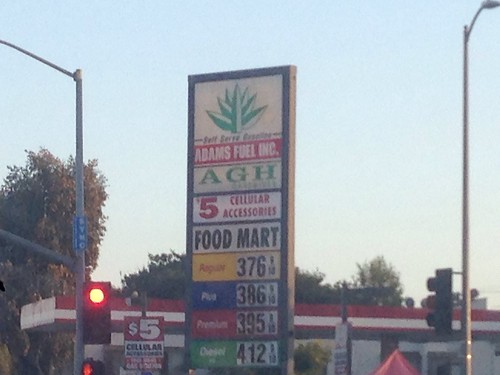
Sign of the times: A dual gas station/marijuana dispensary near USC. One question: Why isn't this place called "Gas 'n' Grass"? C'mon people! Do I have to think of everything?


From my half-assed sleuthing at the Central Library, the reason why Vermont Ave and New Hampshire Ave in L.A. are backwards in relation to the states is due to the fact that the streets weren't named at the same time.
Vermont is a very old street in L.A. terms. It first shows up in 1866. New Hampshire wasn't built and named until 1887, when it was part of one of the developments that sprung up in Southern California during Real Estate Boom I.
Next year at the Central Library, I plan to follow up on my Sepulveda trip with a journey down Western Avenue. Unlike Sepulveda, this should have slightly better scenery and fewer trucks.


For years now, I've been splitting my time between two or three different 24 Hour Fitness gyms, and as such, I've had to pay an additional $5 per month to grant me access to all the clubs at my membership level. This means that every month, I'm supposed to get billed a certain amount for my membership and then the added fee for the all-club upgrade. Pretty standard stuff.
Well, late last week, I moseyed into the gym, and after having my ID scanned in, I proceeded forward to the gym floor.
"Wait!" called out the guy at the front desk. "You're only One-Club."
That was strange. I'd been All-Club for years and years. Why would I suddenly be downgraded to a lesser status? Clearly there had been a mistake.
"Clearly, there's been a mistake," I said. The guy looked back at his computer monitor, which had now been taken over by a big red screen to warn him of my alleged delinquency, and told me that no, I was not eligible to work out at this club.


It's not often you get a cultural lesson from a piece of municipal property, but this actual manhole cover plainly conveys the essence of Los Angeles, day after day, politics and media games aside. The message, etched in steel, is not a call by Chicano nationalists for a reconquest of the American Southwest. It is simply a statement of fact.
How? History tells us that L.A.'s roots and soul were indeed made in Mexico, but so does the present. We're reminded in the way the city is laid out, along the former boundaries of old Californio ranchos. We're reminded in the flavors and sounds of the cultural landscape -- la comida, la vibra. In the faces of the people, who come in every shade of brown mismatched with black and white and yellow and red and everything in between.
Today, Glenn Beck, Lou Dobbs, Jim Gilchrist, and hordes of faceless lieutenants in the relentless hate-talk war against "illegals" too often cloud our historical perspective. In Los Angeles -- the undisputed capital of modern-day Alta California -- even our manhole covers are smarter than that.

In L.A., a movie isn't over at the fadeout; we want to see who was the best boy, who stood in for Julia Roberts and who got the catering gig. For Angelenos, the movie isn't over until the Dolby Sound System logo has appeared, and the house lights have come on.
I used to believe L.A. movie crowds watch the credits with as much interest as the story action because they want to see how many people they know making below-the-line appearances. To recognize names, to claim relationships, is a gauge of professional status in an industry town; it's a competition as much as a curiosity satisfier.
I'm sure that's true for some people, but I'm equally sure that's not the only reason people everywhere linger in the dark while the credits roll.
Take "Atonement," a film with a complicated story that packs a breathtaking emotional punch. Almost from the beginning, the audience is obliged to pay careful attention to the narrative only to be whipsawed into an acutely powerful parallel reality when what we hear, what we see, isn't really what happened, forcing us to experience both extremes of the human passion that informs each version.


